

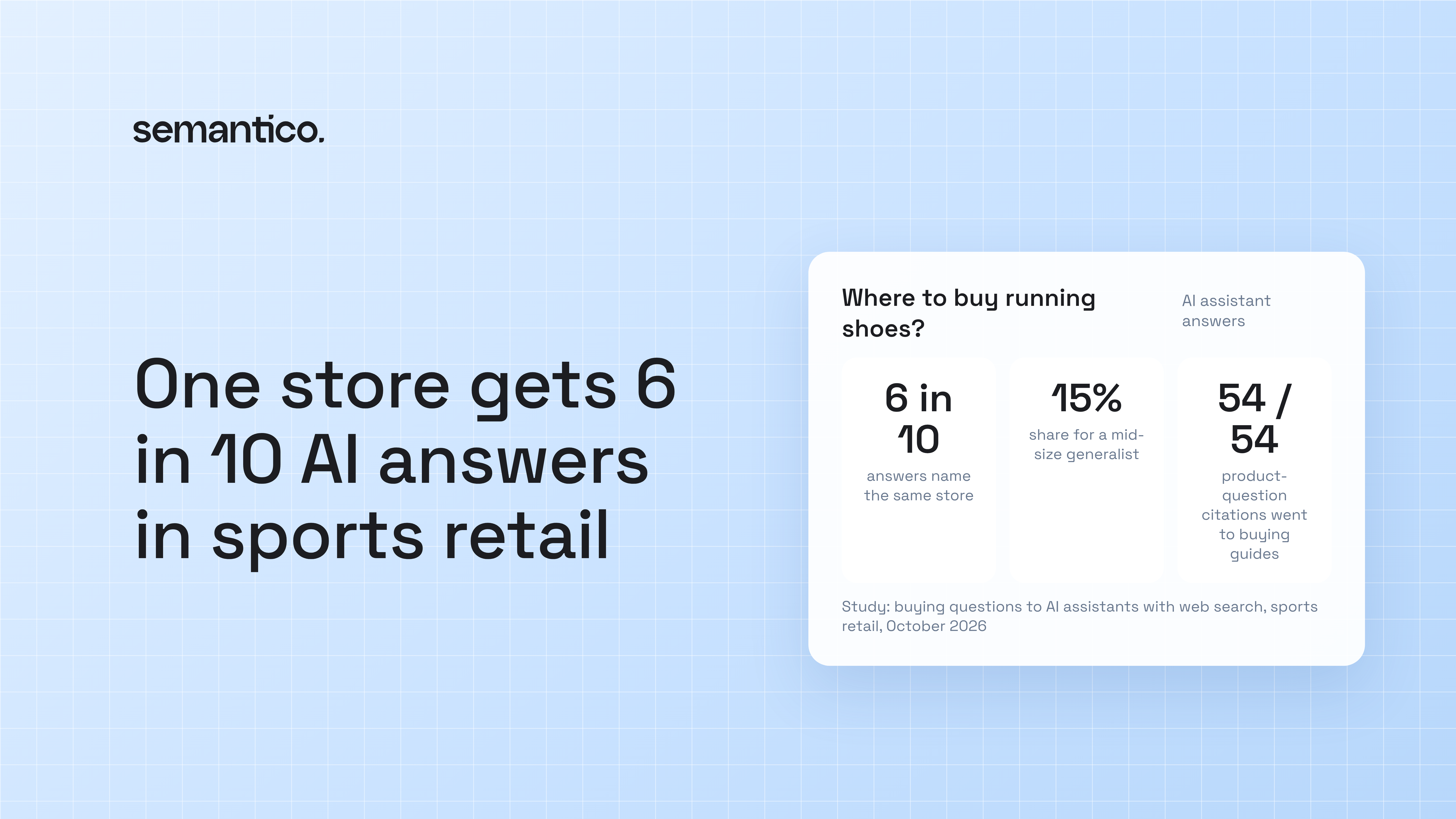
Ask an AI assistant where to buy running shoes and the answer doesn't stop at a shoe. It names a store. When we asked AI assistants real buying questions in sports retail, 6 in 10 AI answers named the same store. The rest of the market shares what's left. That store isn't winning on luck, and the others aren't losing at random: when a store loses a question, the reason is usually one of four, and each one can be seen and fixed.
What we measured
The study: buying questions asked to AI assistants with web search, October 2026, in sports retail. The method, as we publish it: API answers with web search from your market, several samples per question, and only changes beyond the noise. The consumer apps can differ, and we say so.
Three findings stood out.
- In sports retail, one store takes most of the answers. 6 in 10 answers named the same store (58–68%).
- Everyone else shares the rest. 15% share for a mid-size generalist.
- Product questions go to guides. 54 / 54 store citations on product questions went to buying guides, not product pages.
The full numbers are on our AI visibility page.
It's one study in one category, so read it as a picture of how assistants behave, not a law. But the shape matters. A search results page shows ten links and the shopper picks. An assistant writes one answer, and the answer names the stores. If you're not in that answer, there's no page two to fall back on.
This is what GEO (being picked up by AI search and shopping assistants) means for a retailer in practice. The question isn't whether your brand shows up somewhere. It's which store the assistant sends the shopper to when they're ready to buy.
Why a store loses an AI answer
When an assistant recommends a competitor for a question you should win, the cause is usually one of four: a competitor's guide, a review site, missing product data, or a page the AI can't read. Each leaves a trace you can check.
1. A competitor's buying guide answered the question
The 54 / 54 finding is the clearest signal in the study. For product questions ("best running shoes for wide feet", "what to wear for a winter half marathon"), the store that gets cited is the one with a page that helps the shopper choose. Not the one with the product page.
What to check: take the five questions your best category sells on. For each, ask whether you have a page that actually answers it: compares options, explains the trade-off, and links to the products. If the only thing you have is a category grid, the assistant has nothing to quote.
A guide only works if the products it recommends back it up. A guide that says "look for a wide toe box and a 6–8 mm drop" is useless to an assistant if none of your listings say which shoes have a wide toe box or what the drop is.
2. A review site holds the recommendation
Sometimes the assistant isn't citing a store at all. It's citing a third-party review or comparison site, and the store it names is whoever that site links to.
What to check: look at which review sites appear for your category questions, and whether the products they recommend are in your catalog under the same name and model, with the details that let a shopper (or an assistant) tell they're the same product. If your listing calls it something else, you make the match harder.
3. Your product data is missing
This is the one your catalog team owns outright. An assistant can't recommend your store for "trail running shoes with a waterproof membrane" if your listings don't say surface, membrane or waterproofing anywhere. It can't filter what isn't there. You can't filter on adjectives, and neither can an AI shopping agent.
In sports retail the attributes that decide a question are specific and unglamorous: surface (road, trail, track), drop, cushioning level, width, weight, membrane, sizing. Most multi-brand catalogs have them for some brands and not others, because each supplier sends data in its own shape.
What to check: pick one category and list the five attributes your customers' questions actually turn on. Then count how many of your live products carry each one, with a consistent value. "Trail", "trail running", "off-road" and "TRAIL" are four values for one fact.
We wrote about how a missing attribute surfaces as an unanswerable shopper question in Google's new Q&A field will show which attributes you're missing. The same gap shows up in AI answers.
4. The AI can't read the page
The simplest cause, and the easiest to miss. ChatGPT and Claude search the web with their own crawlers, and both companies let sites opt those crawlers out in robots.txt. OpenAI says plainly that "sites that are opted out of OAI-SearchBot will not be shown in ChatGPT search answers". Anthropic says that blocking Claude-SearchBot "may reduce your site's visibility and accuracy in user search results".
What to check: open your robots.txt and look for the assistants' search crawlers. A blanket block added to keep content out of AI training can take you out of AI answers too. Then open one product page with a plain fetch, not a browser, and see whether the attributes are in the page or only appear once scripts run.
What fixing the product data looks like
Causes 1, 2 and 4 are content and technical work your team plans and owns. Cause 3 is a catalog problem, and it's the one that also decides whether causes 1 and 2 can be fixed: a guide needs products with the attributes it talks about, and a review site's pick needs a listing that matches it.
The fix is mechanical, not creative. Define the attribute once, with its allowed values: surface is road, trail or track, and nothing else. Scope it to the categories where it applies, so running shoes get drop and cushioning, and backpacks get capacity. Then generate the values across the whole category from each product's reference, filling only the fields that are empty so the listings your team already wrote are left alone. Every value is reviewed before it's published.
In Semantico that's custom sections (the attributes you define, filled per category) and taxonomies (the controlled list each value is picked from), with generation set to fill gaps only. It's the same normalization problem we described in manual product classification and attribute normalization, now with a new reader: the assistant deciding which store to name.
A check you can run this week
Ask ChatGPT, Claude and Gemini the three questions your best category sells on, a few times each. Write down which store each answer names and what it cites: a guide, a review site, a product page. Then open your own listings for the products in those answers and count the attributes the question turned on.
If the answer names a competitor and your listing is missing the attribute, you've found your first fix. If you'd rather see it measured for your store, in a couple of hours, by email, with no call and no access to your store, the audit shows your share against the top stores, five questions you win, five you lose, and the top cause behind them.