

Google Merchant Center now has a field for product FAQs, and it feeds the answers shoppers get in AI Mode. Most teams will treat the question and answer attribute as a writing task: hand someone a spreadsheet, ask for ten good questions per product. That misreads it. A useful answer to "Is this suitable for under-12s?" or "Will it fit a 16-inch laptop?" is a lookup on a structured attribute. If the attribute exists, the answer writes itself. If it doesn't, the answer is either invented or missing. So the Q&A field is really an audit, and it will show you exactly which attributes your catalog lacks.
What Google added to Merchant Center
In May 2026 Google introduced six conversational attributes in Merchant Center: question and answer, document link, related product, item group title, variant option and popularity rank (Search Engine Roundtable covered the launch). Google describes them as helping "AI systems and conversational agents better understand your products' specific nuances", with AI Mode in Search as the main surface.
The question and answer attribute is the one that maps most directly onto what a shopper asks. The rules are specific:
- Up to 30 question and answer pairs per product.
- Each question and each answer up to 1,000 characters, with a 10,000-character cap per product.
- Only information about the product, no prices or dates, and answers that are "correct and informative".
- No repeating what's already in the description, product highlights or product details.
The fields are optional and Google says adding them won't affect the approval status of existing products.
On 16 September, in its holiday shopping update, Google said that during testing with lululemon, the conversational attributes the brand submitted "were incorporated 50% of the time in relevant product recommendations in AI Mode". That's Google's own figure, from one brand, with no published methodology. It's still a signal of where Google wants product data to go.
Every good answer is an attribute lookup
Take the questions shoppers actually ask before they buy, and look at what it takes to answer them truthfully.
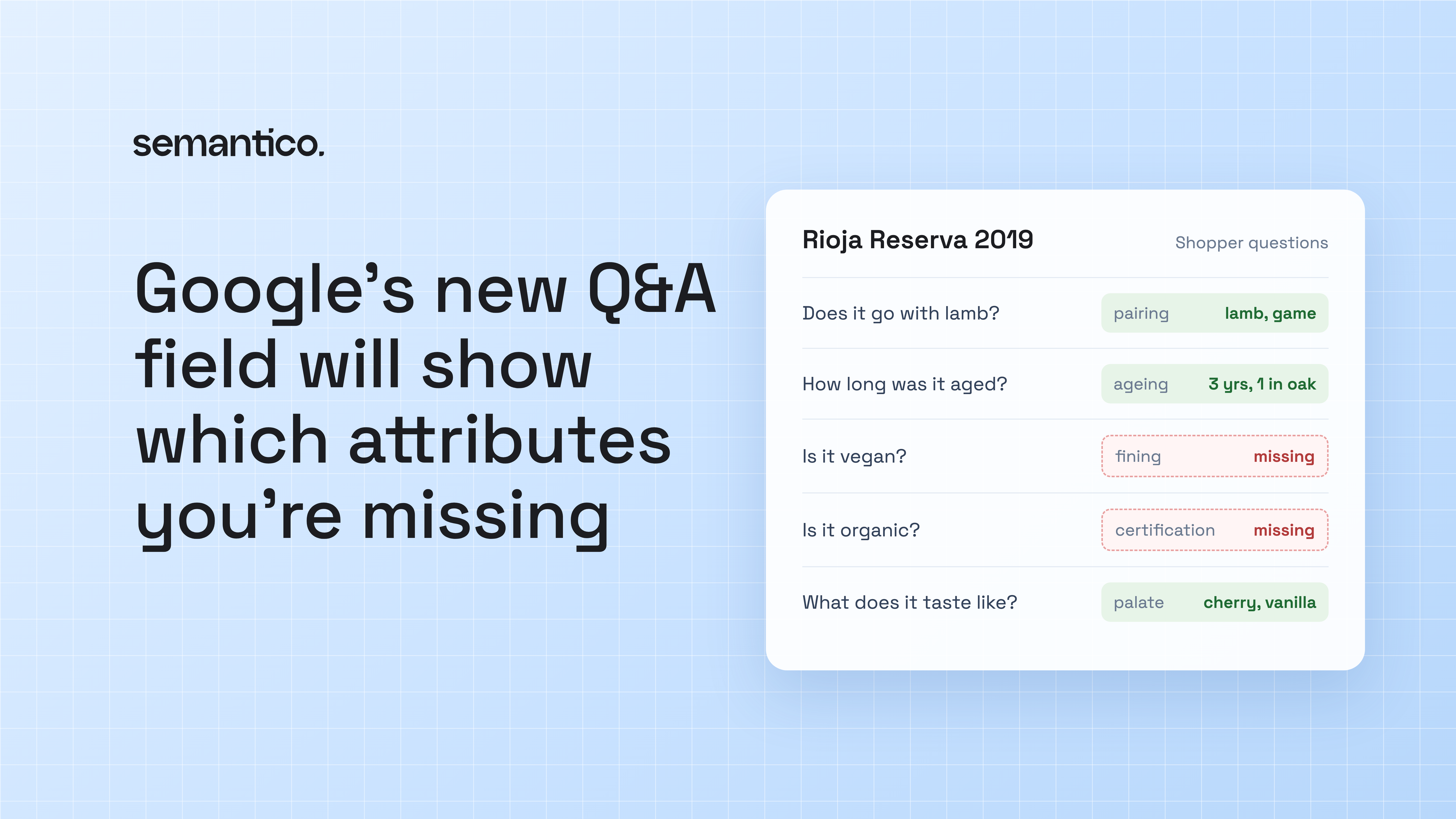
In wine, "Does this go with lamb?" needs a pairings attribute. "Is it vegan?" needs to know how the wine was fined. "How long was it aged?" needs the classification, and in Rioja that's a legal category: Crianza, Reserva and Gran Reserva each set a minimum ageing period, from two years for a red Crianza to five for a Gran Reserva. You can't answer it from the tasting note.
In pharmacy and parapharmacy, "Can my 8-year-old use this?" needs a minimum age. "Is it fragrance-free?" needs an ingredients or free-from attribute. A wrong answer here isn't a lost sale, it's a complaint.
In electronics, "Will it fit a 16-inch laptop?" needs the internal compartment dimensions, not the external ones. "Can I charge it over USB-C?" needs the charging port, which often lives only in the manufacturer's PDF.
None of these is a writing problem. Each one is a single value in a single field. When the field is filled, the answer is one sentence anyone can write, or generate, and it stays correct when the product changes. When the field is empty, the person writing the FAQ has three options: go and find the fact (which is enrichment, done slowly, one SKU at a time), guess, or skip the question.
Why writing FAQs by hand makes it worse
Google's rules already push you toward attributes. Answers must be correct, and they mustn't duplicate the description. So the description you've polished doesn't count. What's left are the specific facts the description never covered.
A copywriter without those facts will do what copywriters do: write around the gap. "This versatile red pairs well with a range of dishes." That's prose, and it gives an AI shopping agent nothing to match against "a red for roast lamb under £20". Worse, a confident wrong answer now travels further than your product page ever did, into an AI answer you don't control.
Then there's the scale. Thirty pairs is the limit, not the target, but even ten questions across a hypothetical 5,000-SKU catalog is 50,000 answers to write and keep current. That's the manual workflow again, and the team isn't the bottleneck, the workflow is. Fix the attribute once and the answer, the on-site filter and every other channel's feed all improve at the same time. Write the FAQ by hand and you've fixed one field in one channel, until the next product update makes it stale.
This is also why the Q&A field matters beyond Google. Every AI shopping agent, Google's or anyone else's, can only answer from the data it's given. Getting picked up by AI search and shopping assistants (what's starting to be called GEO) depends on the same structured attributes, whichever surface is asking. We made a similar argument about Google's Universal Commerce Protocol in January: your product data is now your storefront.
The ten-question audit for the question and answer attribute
You can run this on one category in an afternoon, before anyone writes a single FAQ.
1. Pick one category that matters commercially. One, not the whole catalog.
2. Collect the ten questions shoppers ask most about it. Good sources: customer service tickets, on-site search queries, product reviews, the questions your store staff get, and the "People also ask" box on Google for the category.
3. Next to each question, write the attribute that would answer it. "Is it dishwasher-safe?" → care instructions. "Does it come in a 75 cl bottle?" → bottle size. If you can't name an attribute, the question is about opinion and probably isn't worth a Q&A pair.
4. Check the fill rate of each attribute across the category in your PIM or product export. Not "does the field exist", but "what share of products have a real value in it".
5. Score it. How many of the ten questions can your catalog answer for most of its products today?
The result is two lists. Questions you can answer now: generate those Q&A pairs from the attributes and submit them. Questions you can't: that's your enrichment backlog, ranked by what shoppers actually ask, which is a better order than most backlogs have.
Fill the gaps at the catalog, not in the feed. The same attribute that answers the question in AI Mode also becomes a filter on your own site, a field in your marketplace listings and a fact any other AI shopping agent can read.
In practice, working through that backlog looks like this. Define each missing attribute once for the category (pairings, fining, minimum age, internal compartment size), with a controlled list of allowed values wherever the answer is a choice, so "vegan" doesn't arrive as "Vegan", "suitable for vegans" and "yes". Generate the values across the category from each product's reference, with overwriting switched off so only empty fields are filled and the content you already trust stays as it is. Review the values, publish them to the store, and the Q&A pairs become a lookup on data you've checked.
Semantico does this from a SKU or EAN: custom sections for the attributes, taxonomies for the allowed values.