

In wine eCommerce, the catalog is the storefront. Every tasting note, every food pairing, every structured attribute (acidity, alcohol %, grape, region) is a chance to be found in search, to be picked up by AI shopping assistants, and to convert a curious browser into a buyer. Wines that ship without that information aren't just under-described, they're under-sold.
That was the problem Vinoselección, one of Spain's leading wine specialists, set out to solve. Their team knew exactly what a great wine listing looked like, they just couldn't produce them at the scale and speed the catalog demanded. Manual enrichment was taking 20 to 30 minutes per wine, leaving most of the catalog under-enriched and several markets unaddressed.
With Semantico, that work now takes under 30 seconds. The catalog is being enriched continuously, descriptions, tasting notes, structured attributes, and translations rolling out wine by wine, across five languages. And the markets that were previously cost-prohibitive are open.
The Challenge: Rich Catalogs Don't Scale on Manual Effort
Vinoselección's process was thoughtful but slow. Wine information arrived in every imaginable format, from supplier PDFs, CSV exports, datasheets to technical specifications and a dedicated team turned that raw input into bespoke product descriptions and tasting notes for each bottle. The output was good. The throughput wasn't.
The team also wanted to expand each listing with a richer set of structured attributes — acidity, alcohol percentage, grape varieties, region, recommended food pairings — the kind of detail that drives long-tail SEO, improves GEO discoverability, qualifies traffic, and lifts conversion. But adding that data manually across the full catalog was prohibitively expensive in time and headcount. So the richest listings stayed reserved for the bestsellers, and the long tail of the catalog stayed thin.
On top of that, international expansion meant translating thousands of bespoke listings into multiple languages, and not just any translations. Wine has its own vocabulary. 'Crianza,' 'Reserva,' and 'Gran Reserva' aren't grades of 'aged' — they're legal classifications with specific oak and bottle requirements. 'Cosecha' carries both 'harvest' and 'vintage' depending on context. Off-the-shelf translation tools flatten these into generic English and lose the precision wine buyers actually search on. A literal translation reads as foreign at best and amateur at worst, and brand-trust damage is hard to undo. So new markets stayed on the roadmap rather than the storefront.
The pattern is familiar: the team isn't the bottleneck, the workflow is. Slow catalog velocity isn't an efficiency problem. It's a revenue problem.
The Solution: Type in the Wine and Year. Semantico Does the Rest.
Vinoselección replaced the manual write-up with Semantico's catalog automation platform. The new workflow is almost embarrassingly simple: their team enters the name and the vintage of a wine. Semantico does everything else, in seconds.
Behind that single input, Semantico fuses information from Vinoselección's own supplier PDFs and trusted online wine sources, then generates the full listing: on-brand, structured, and ready to publish. Specifically:
- Product descriptions written in Vinoselección's voice, not generic AI prose, but copy that matches how the brand talks about wine.
- Tasting notes with the sensory specificity (nose, palate, finish) that wine buyers actually read before they click "buy."
- Food pairings: the long-tail SEO & GEO discoverability goldmine. "Wines for paella," "reds for grilled lamb," "whites for sushi": these are high-intent search queries that pull qualified buyers directly to a product page.
- Structured attributes: acidity, alcohol %, grape varieties, region, ageing, body. The data that powers faceted filters, comparison shopping, and discoverability across AI shopping assistants.
- Any additional metadata the team needs: serving temperature, ageing potential, sustainability claims, awards. If it lives in the source data, Semantico can extract and structure it.
And critically for international growth: Semantico applies specialised translation rules per language, tuned for the wine domain. The output reads as if it was written by a wine specialist in that market, not translated from Spanish.
The team's role shifts from writing to approving and improving. Same expertise, different leverage.
The Results: Every Wine Sellable. Every Market Open.
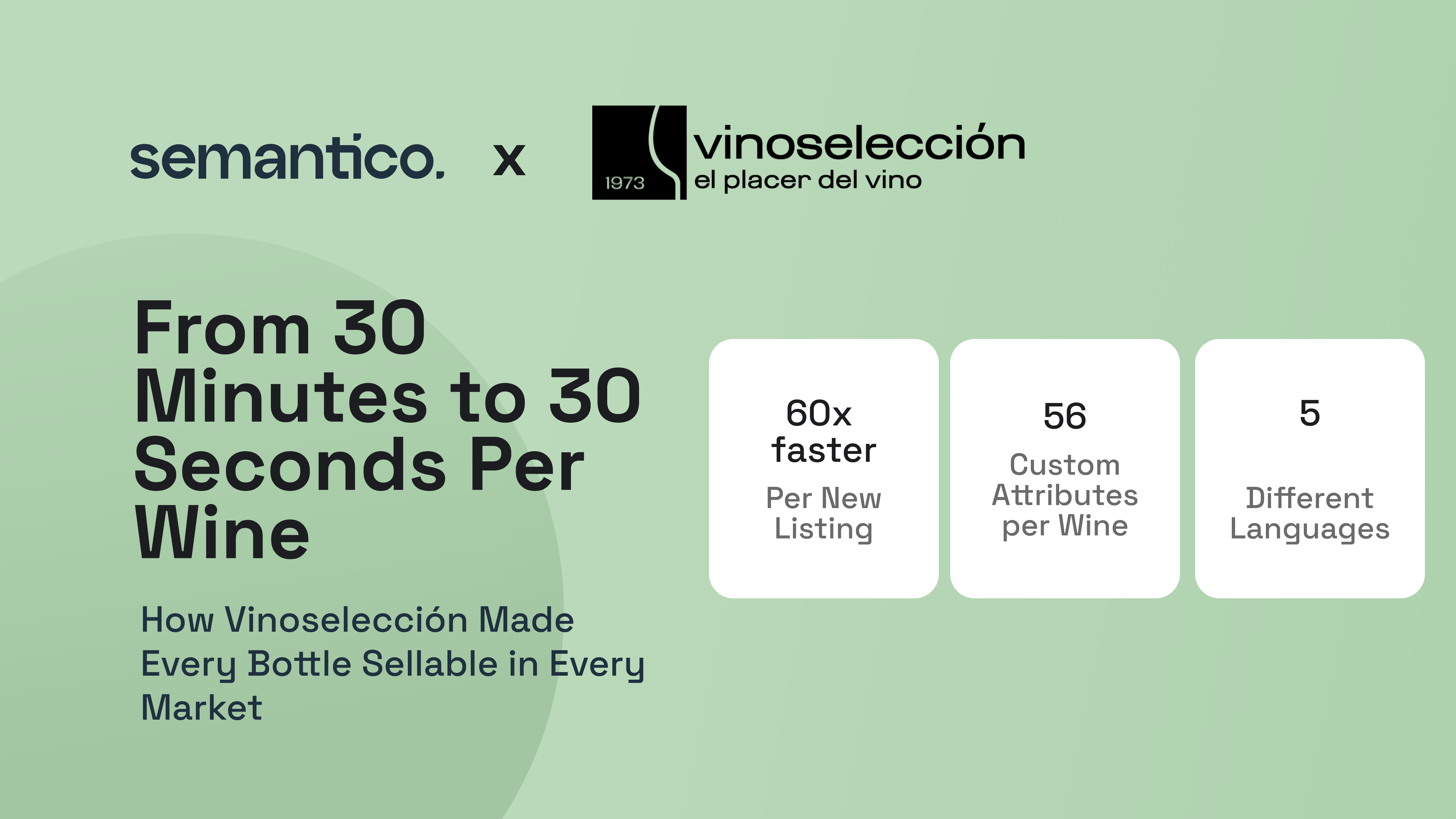
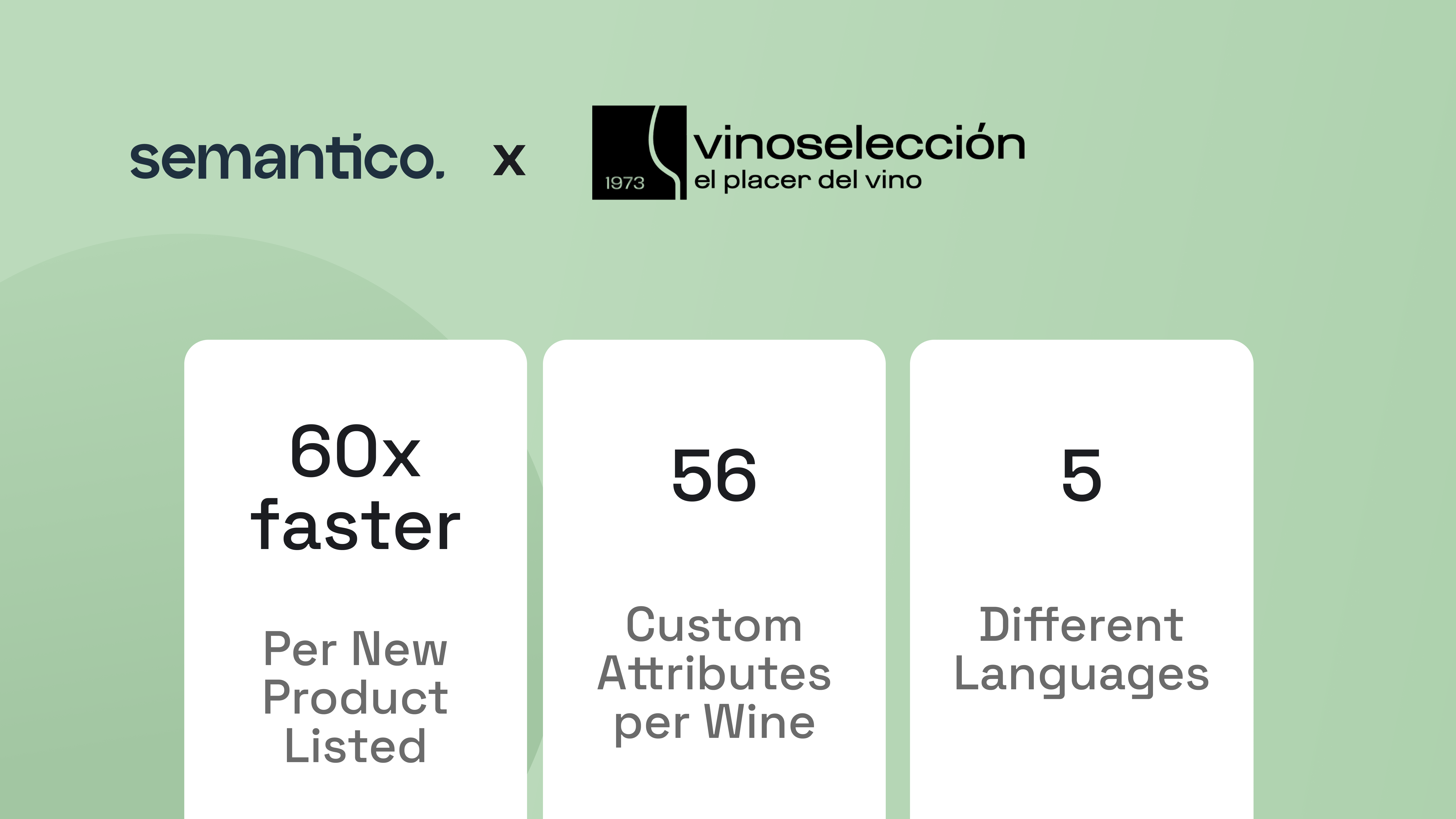
60× faster per listing
What previously took 20–30 minutes per wine is now completed in under 30 seconds. That's roughly a 60× reduction in time-to-listing, but the more important number is what that unlocks.
56 custom attributes per product, in 5 languages
Where most catalogs ship products with five to ten attributes, every Vinoselección wine is now structured around fifty-six: acidity, alcohol percentage, grape varieties, ageing, body, region, recommended food pairings, and dozens more. That's the depth that powers faceted filters, comparison shopping, long-tail SEO, GEO discoverability (the kind of structured queries AI shopping assistants now use to recommend products to buyers). And every one of those attributes ships in five languages, so the depth doesn't collapse at the border.
83 wines, 610 AI tasks, 67% catalog complete and climbing
In a matter of months, Semantico has executed 610 AI tasks on Vinoselección's catalog, generating descriptions and tasting notes, structuring attributes, producing translations across 83 wines to date. The catalog is currently 67% complete in this enriched format, with the remainder rolling out on a continuous cadence rather than as a multi-quarter project. The compounding effect: each week, more of the catalog becomes findable, comparable, and conversion-ready in more markets.
“56 attributes. 5 languages. Per wine. That used to be a luxury we could only afford on our bestsellers. Now it's the standard across the catalog. The long tail of our wines is finally pulling its weight.” — Marta Inglés, Marketing Director at Vinoseleccion.
What This Unlocks: From Catalog Operations to Catalog as a Growth Engine
The headline number — 30 minutes to 30 seconds — is the easiest part of this story to tell. The harder, more interesting story is what changes when the per-wine cost of enrichment drops by that much.
Every wine becomes worth listing properly. Niche bottles, low-volume vintages, allocations from small producers. These used to be "good enough" listings because rich enrichment couldn't be justified for them economically. Now they ship with the same fifty-six-attribute depth as the bestsellers. That's incremental revenue from inventory the team already had, and it compounds with every wine the platform processes.
New markets stop being multi-quarter projects. When translation is part of the workflow rather than a downstream project, expansion becomes a planning question, not a capacity question. Vinoselección can address language markets in the time it used to take to do a single product line.
The team focuses on judgement, not data entry. The wine specialists at Vinoselección are still in every listing, but as approvers and curators, not assemblers. Their expertise scales across the full catalog instead of being rationed to the most important wines.
And the listing itself becomes an SEO asset on day one. Structured attributes and food-pairing copy are exactly what search engines and AI shopping assistants reward. "We'll optimise later" is replaced by "it's optimised at publish."
The Lesson: Slow Catalog Velocity Is Lost Sales
Vinoselección's transformation isn't really a story about AI or efficiency. It's a story about what gets unlocked when catalog velocity stops being the constraint. List faster. Rank higher. Sell more, across more markets, more SKUs, and more languages than the manual workflow could ever reach.
If your team is enriching only the bestsellers because the long tail isn't worth the time, or if your international expansion has been waiting on translation budget, the bottleneck isn't capacity. It's architecture.
Download Vinoseleccion Success Story PDF
Let's see it on your products.
Share 3–5 wines from your catalog. We'll generate complete, multi-language, SEO & GEO-ready listings in minutes.